
Home Care Services
Support at Home Program
For older Australians with ongoing or more complex care needs, the Support at Home program provides personalised and coordinated services to help you live safely, independently, and comfortably in your own home.

The Support at Home program commenced on 1 November 2025, replacing the Home Care Packages Program and Short-Term Restorative Care Programme.
At PAWA Community Care, we see this as an opportunity to continue doing what matters most: providing reliable, personalised care that helps older Australians remain independent, connected and comfortable in their own homes.
While the funding and administration of home care have changed, our commitment to you has not. We take the time to understand your needs, preferences and goals and work with you to deliver care that fits your life.
What is Support at Home?
Support at Home is designed to help older people remain living safely and independently at home for longer. Your aged care assessment determines the care and services you are eligible to receive, based on your individual needs and goals.
Depending on your assessment and support plan, services can include:
Clinical Supports
Clinical care is fully funded by the Australian Government and can include services such as:
Nursing
Allied health services
Physiotherapy and occupational therapy
Podiatry
Other approved clinical supports
Independence
These services are designed to help you remain independent and safely manage everyday activities. They can include:
Personal care
Assistance with daily activities
Continence support
Transport
Social support
Respite
Assistive technology and equipment, where approved
Important: From 1 October 2026, approved personal care services will move into the Clinical Supports category and will be fully government funded. This means there will be no out-of-pocket contribution for approved personal care services, provided you have available Support at Home funding.
Everyday Living
These services help you maintain your home and continue your usual lifestyle. They can include:
Domestic assistance and cleaning
Laundry
Meal preparation
Gardening
Home maintenance
Shopping and other approved everyday living supports
You can find the full range of services available under Support at Home in the Australian Government's Support at Home service information.



Your Support at Home funding
Your Support at Home funding is based on your assessed needs and goals.
For ongoing services, there are eight Support at Home funding classifications. Your aged care assessment determines your classification and the corresponding budget available for your care.
Your ongoing funding is provided as a quarterly budget, rather than as one annual amount. Your budget is held and managed on your behalf, and PAWA will work with you to plan and coordinate your approved services.
You can find the current funding classifications and budgets in the Australian Government's Support at Home funding information.
What will I need to pay?
Support at Home participant contributions depend on the type of service you receive and your individual financial circumstances.
Clinical Supports: no participant contribution.
Independence: a moderate contribution may apply.
Everyday Living: a higher contribution may apply.
Your contribution rate is determined through an income and assets assessment. You can use the Australian Government's Support at Home fee estimator to get an estimate of what you may need to contribute.
From 1 October 2026, approved personal care services will be fully funded by the Australian Government and will not require an out-of-pocket contribution.
For current contribution rates and further information about Support at Home costs, visit My Aged Care – Support at Home costs and contributions.
How PAWA can help…
Navigating aged care and understanding your Support at Home funding can feel complicated. You don't have to work it out alone.
At PAWA, we can work with you, your family or supporters, and your care team to understand your approved services and develop a support plan that reflects what is important to you.
Our focus is on providing person-centred, respectful and dependable care — supporting you to maintain your independence while staying connected to the people, routines and community that matter to you.
Whether you are new to Support at Home or transitioning from a Home Care Package, our team is here to help you understand your options and arrange the support you need.
Have questions about your care?
If you would like to discuss Support at Home, our services or how PAWA can support you at home, please get in touch with our team through our contact page.
1. Get Assessed
Complete an aged care assessment through My Aged Care to determine your eligibility and the level of support you need.
Your Path to Support at Home
2. Receive Your Funding
Based on your assessment, you'll receive an individual Support at Home budget that reflects your care needs.
3. Create Your Care Plan
We'll work with you to develop a personalised care plan that aligns with your goals, preferences, and lifestyle.
4. Start Receiving Support
Our care team will coordinate your services, regularly review your care, and adjust your support as your needs change, helping you continue living independently at home.
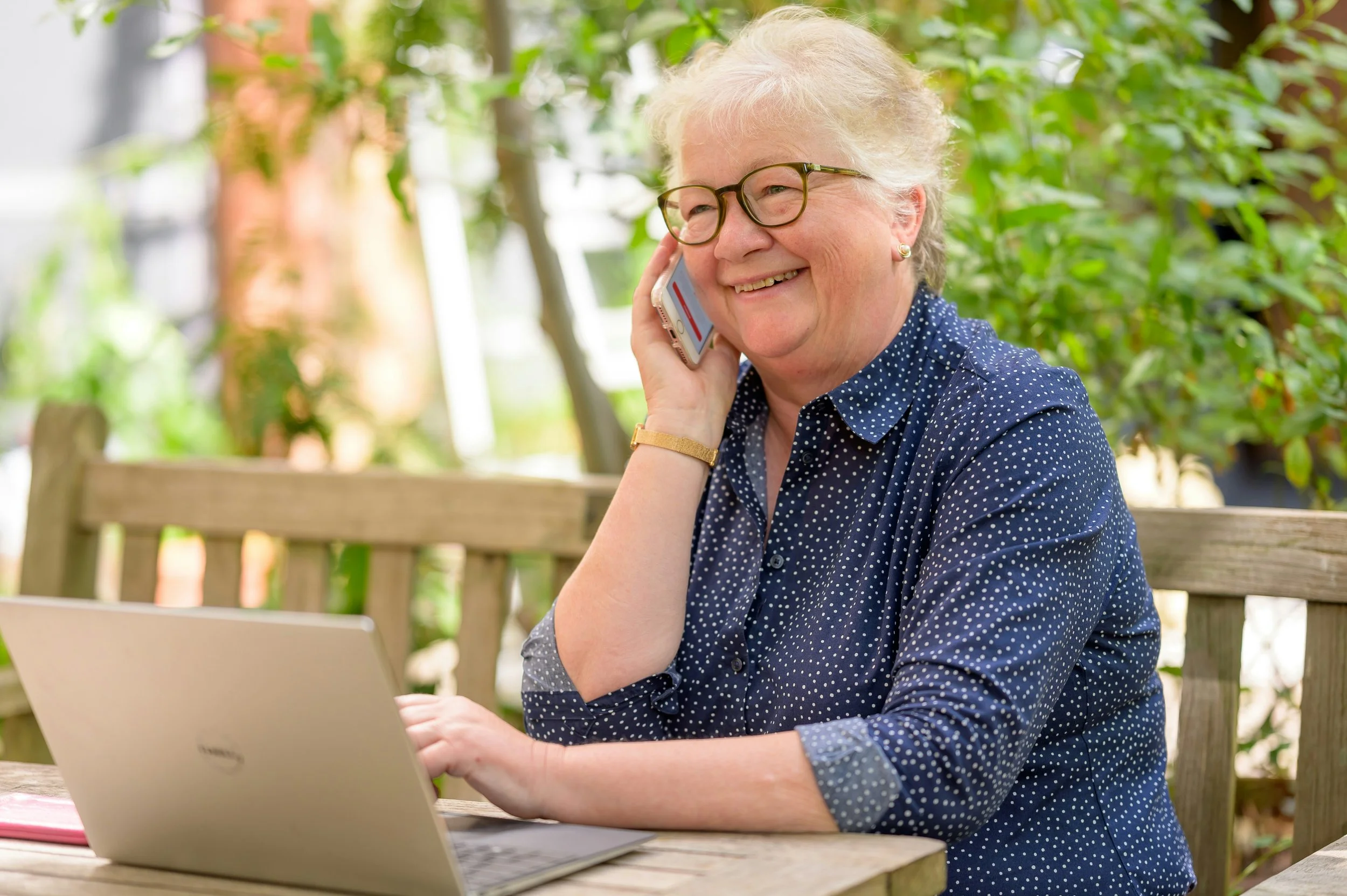
Ask PAWA which support services are available in your area
Call 1300 227 292
(Mon–Fri, 8.00am–6.00pm AEST)
or email info@pawacc.org.au
Support at Home Program Fees & Financial Assistance
Under the Support at Home program, the Australian Government expects all people to contribute towards the cost of their care, if they can afford to do so.
The amount you need to contribute towards the cost of your care is called your Contribution Rate and is determined by Services Australia. Your Contribution Rate based on your income and assets, as part of an Income and Means Assessment.
If you have not completed an Income and Means Assessment, your Contribution Rate will be set to the government's default level of 80% of the cost of Everyday living supports, and 50% of the cost of Independence supports. All Clinical support is fully funded by the Australian Government, so these services are at no cost to you.
Full pensioners
Full pensioners contribute 5% for Independence services and 17.5% for Everyday Living services
Part pensioners
Part pensioners contribute between 5% to 50% for Independence services and between 17.5% and 80% for Everyday Living services, depending on income and assets
Self-funded retirees
Self-funded retirees contribute 50% for Independence services and 80% for Everyday Living services
Income and Means Assessment
To calculate your contribute rate, Services Australia will assess your income and assets, including your pension status. For full and part pensioners, your assessment will use information that you have already provided to Services Australia for a pension assessment. If you already have a pension or a Commonwealth Senior Health Card, you will pay a lower contribution.
How your contribution is calculated
There are three categories of aged care services, and your Contribution Rate is also based on the type of services you may receive.
Clinical Supports: Services like Nursing Care and Allied Health care like Physiotherapy are fully funded by the Australian Government. out of hospital and residential aged care. This means you will not be required to pay a contribution.
Independence Supports: Financial contributions are required for services like Personal Care, and assistive equipment and products.
Everyday Living Supports: A higher level of financial contribution is required for services like Domestic Assistance and Gardening.
Based on your income and assets, each type of service has a fixed contribution percentage. Your contribution is calculated per hour, or unit of service, for each service received.
For example:
For two hours of Personal Care, you pay a contribution towards the cost of each hour of your service.
If you received five meals, you pay a contribution towards each meal, as it’s billed as a unit of service.
If you have consumables like continence pads, your contribution is calculated as a percentage of the product’s cost.
Your Care Partner will explain the payments you need to make when developing your Care Plan.
Our Support at Home Program Contribution Fees
* from 14th August 2026
See our full Support at Home Price Guide including Basic Daily Fees, Management Fees, Overnight Care / Sleep Over Fees and Clinical Care Fees view our download here:
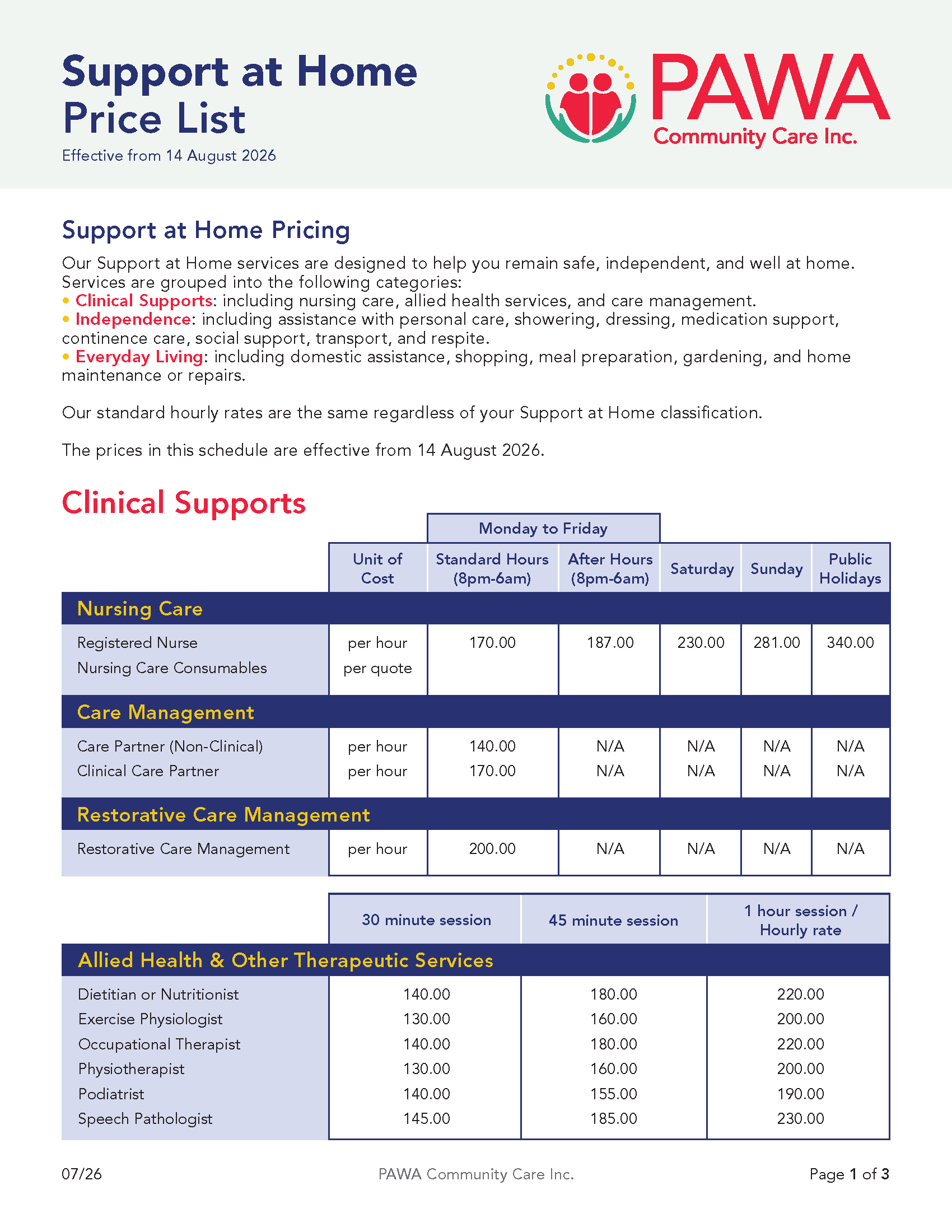
View or Download our SAH Price Guide below (PDF):
Additional Conditions
Cancellation Policy: A cancellation fee equal to the full cost of the scheduled service applies to cancellations made with less than two (2) business days’ notice. If sufficient notice is not provided, the full service fee may be charged.
Exceptions may apply, and the cancellation fee may be waived on a case-by-case basis where there are reasonable grounds.
Preferred Worker or Subcontractor Requests: If you choose your own sub-contractor or request a preferred worker to deliver services, this may attract a higher rate and we will supply a quote.
Price Increases: Our prices may increase up to twice per financial year with at least 14 days’ notice, by the greater of 5%, any increase in CPI, average wage increases for home care staff or increases in operational costs.
For queries, please contact our friendly team on 1300 227 292

Estimating and confirming your contributions
You can use the Support at Home fee estimator on myagedcare.gov.au to estimate how much you may need to contribute towards your Support at Home services and to help plan your budget. The estimator asks for information about your pension status, income and assets.
Your actual contribution rates are determined through an income and assets assessment. Services Australia generally completes this assessment. If you receive a means-tested payment from the Department of Veterans’ Affairs (DVA), DVA may complete the assessment instead.
If you are a full or part pensioner, Services Australia will generally use the income and assets information it already has from your pension assessment. If you are a Commonwealth Seniors Health Card holder or a non-pensioner, such as a self-funded retiree, you may need to provide your current financial information if Services Australia does not already have it.
If you are a member of a couple, half of your combined income and assets is included in the assessment, regardless of who earns the income or owns the assets.
To have your contribution rates calculated, you can complete the Support at Home calculation of your cost of care form (SA456) through Services Australia. You can also apply online through your Centrelink online account via myGov. You don't need to complete SA456 if Services Australia already has the financial information it needs from a relevant income support payment.
Once your assessment is complete, Services Australia will send you a fee advice letter showing the contribution rates that apply to you. You can have your income and assets assessed before you start receiving care, but your fee advice letter is valid for 120 days from the date of your assessment. If you don't enter care within that period, you may need another assessment.
If you choose not to provide your income and assets information, you will be given a ‘means not disclosed’ status and will be required to pay the maximum contribution rates.
Under Support at Home, the amount you contribute also depends on the type of service you receive. Clinical supports are fully funded by the Australian Government, while contributions may apply to independence and everyday living services. From 1 October 2026, approved personal care services will move into the clinical supports category and will be fully government funded, meaning you will not pay a contribution for approved personal care services delivered from that date.
Financial advice, education and assistance
You should consider obtaining independent financial advice before deciding how to manage or pay for your aged care costs. The way you arrange your finances may affect your pension and aged care costs.
Services Australia's Financial Information Service (FIS) provides free information and education to help you understand your financial options, including the financial implications of aged care. FIS Officers can explain financial matters and help you make informed decisions, but they are not financial planners or financial counsellors and do not provide personal financial advice.
To speak with a Financial Information Service Officer, call 132 300 and say “Financial Information Service” when prompted. The Older Australians line is available Monday to Friday, 8 am to 5 pm.
Financial hardship assistance
If you are experiencing genuine financial hardship and cannot afford your Support at Home contributions for reasons beyond your control, you may be able to apply for financial hardship assistance, also known as a fee reduction supplement.
Eligibility is assessed on an individual basis. If you are eligible, the Australian Government may pay some or all of your Support at Home contributions.
For more information, including eligibility requirements and how to apply, see Financial hardship assistance on myagedcare.gov.au.

Why Choose PAWA?
PAWA is a community-centred not-for-profit organisation, that has been in the aged care space for over 50 years. Our focus is on giving back to the ageing population, by fostering communities of belonging and supporting seniors to continue living in the comfort of their own home. Our team are there to ensure that each client is able to maintain independence, dignity, and respect.
We’ll work with you and your family to find the right level of care for your unique set of circumstances. At PAWA, we’re here to help you navigate this next stage of life with ease.
Maintain Independence
Personalised care plans tailored to your unique needs and preferences.
Assistance with daily tasks like shopping & cleaning, allowing you to focus on what you enjoy.
Empowering you to stay in control of your daily routine and decisions.
Compassionate Quality Care
Trained and experienced team dedicated to providing high-quality support.
Our team who build a rapport with you, ensuring trust and reliability.
Comprehensive safety measures and background checks for peace of mind.

Flexible Services
Care that adapts to your changing needs and preferences
Flexible scheduling to fit your lifestyle and preferences.
Ability to increase or decrease services based on your current health and requirements



Testimonials
“The team at PAWA - the Care Manager, the rostering team and the amazing Care Workers are all such lovely people. The whole client’s family appreciate everything that is provided to their Aunty. At 99, the client is still full of energy and looks forward to every visit. Client considers herself very luck to live here in Australia and be able to receive support from such a great team.”
— Client under HCP

“I’m very happy with the support received from PAWA thus far, especially with close support from Care Manager. The communication with is great, they are very responsive to any requests/queries and makes sure that services are going well. I am very satisfied and grateful with support services provided by PAWA because they improve my wellbeing.”
— Client under HCP

“Support by Polish speaking workers is absolutely necessary as my mum who doesn’t speak English. We are very happy and grateful for having your lovely, nice, helpful ladies to take care of her. The Care Worker attending the service is simply brilliant, is a blessing for my mother, making her mother happy. She is always looking for the services with her care worker.”
— Client under CHSP

Enquire Online
Submit an enquiry using the form below and one of our team members will contact you within 24hrs or email us at info@pawacc.org.au

Book a Free Consultation
Book a call or visit with us! We’ll be happy to answer all of your questions about our Aged Care Services and clarify any concerns you have about the process. We can also provide you with advice if you’re looking to make a switch from your current provider - let us know and we’ll guide you through the process.
Our staff will discuss everything from you or your loved ones requirements to concerns, surroundings, lifestyle and preferences to better understand the type of care you need.