
Costs & Funding
PAWA Community Care Inc is committed to offer our clients high quality services at affordable and competitive prices.

PAWA Community Care’s primary focus in the provision of services via the Support at Home program and Commonwealth Home Support Program is to help you stay independent in your home for longer.
Our team can help you navigate government funding available so you can make informed choices about what is best for you.
We are a not-for-profit association and when setting our prices we are aiming to:
Ensure charges for all care and services are reasonable.
Keep our pricing information up to date and publish our prices on My Aged Care portal
Ensure financial viability of our organisation whilst keeping fee increases to a minimum to minimise their impact on our clients
The home care service fees you pay will depend upon the services you need and the funding allocated to you.
When you receive funding from the government for Support at Home or CHSP services, you have either individual a budget to pay for the services you need (Support at Home) or funding allocated to us as a provider to deliver services you we assessed for (CHSP).
You are in control of your care, how you choose to use funding, so you have choice and flexibility in the way your support services are delivered. At PAWA Community Care your Care Manager will assist you in choosing services to make the most out of your funding and budget.
Our staff are available to provide information about our fees and charges and help you create a support and care plan that suits your needs. Simply contact us on 1300 722 400 and speak to our care experts.
Subsidised Government Funding
The Australian Government subsidises a range of aged care services - depending on your circumstances, care needs and assessment outcome, our services can be accessed through the Commonwealth Home Support Programme (CHSP) or a Support at Home Program.
The Commonwealth Government is the major funder of aged care, with clients contributing to cost of their care. Aged care is available to all older people regardless of their means.
Fees differ between programs and depend on your individual circumstances, types and level of support you require. Consideration is given to clients who are assessed as financially disadvantaged.
The government contribution is paid directly to the home care provider you choose. You work in partnership with the provider to determine the care and services you need, within the package budget or based on services you were assessed for under CHSP.
To apply for funding support to receive care in your home, you will first need to register with and be assessed by My Aged Care.
All applications for government-funded aged care services are made through the government portal, My Aged Care.
Visit My Aged Care:
www.myagedcare.gov.au
Call My Aged Care:
1800 200 422
Commonwealth Home Support Program (CHSP) Fees and Charges
The Commonwealth Home Support Program (CHSP) helps older people access entry-level support services to live independently and safely at home. An aged care assessment determines eligibility for the CHSP, including specific services.
CHSP is subsidized by the government, based on specific unit of subsidy for services allocations for each provider but you will be required to pay a co-contribution for each service that you use to your chosen provider, such as PAWA Community Care. The level of co-contribution is set individually by each provider.
This contribution will differ significantly from person to person. It’s based on your income, including your pension. Individual circumstances and capacity to pay are taken into consideration when commencing services with us.
PAWA Community Care’s fee structure is simple and transparent, putting you in total control. The amount spent depends on how much and how often you use our services. You are in control of your care, you have choice and flexibility in the way your support services are delivered.
At PAWA the fees for our CHSP service are based on an hourly rate, charges for kilometres travelled with client or number of trips (transport service).
In setting of fees, we are guided by The National Client Contribution Framework
The National CHSP Client Contribution Framework (the Framework) aims to ensure that clients who can afford to contribute to the cost of their care do so, while protecting those most vulnerable.
Please contact our care managers to discuss your individual circumstances.
Our CHSP Program Contribution Fees
* from 1st July 2026
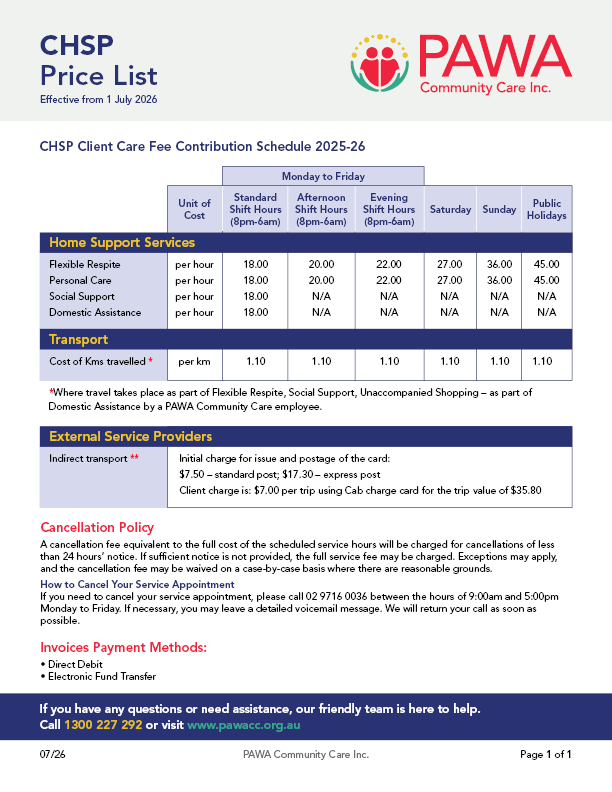
See our full CHSP Price List including Day, Afternoon and Overnight / Sleepover Shift Fees and Transport Fees:
View or Download our CHSP Price List below (PDF):
Our CHSP Fees
* from 1st July 2026
|
Hourly Rate - Flexible Respite & Personal Care |
Hourly Rate - Social Support & Domestic Assistance |
|
|---|---|---|
| Day Shift (6am-8pm) | $18 | $18 |
| Evening Shift (8pm-12am) | $20 | $18 |
| Night Shift (12am-6am) | $22 | N/A |
| Saturday | $27 | N/A |
| Sunday | $36 | N/A |
| Public Holiday | $45 | N/A |
Transport
Initial charge for issue and postage of the card:$7.50 – standard post; $17.30 – express post
Client charge is: $7.00 per trip using Cab charge card for the trip value of $35.80
In Service Travel - Use of Vehicle
Where travel takes place as part of Flexible Respite, Social Support, Unaccompanied Shopping - as part of Domestic Assistance.
A fee of $1.10 per kilometre is chargeable for transport with you provided during a visit.
This is in addition to the standard hourly rate.
Additional Conditions:
*If your scheduled care runs over the scheduled time, you will be charged for the additional time.
*A cancellation fee equivalent to scheduled service hours will be charged for cancellations of less than 24 hours’ notice.

For queries, please contact our friendly team on 1300 227 292
Support at Home Program Fees & Financial Assistance
Under the Support at Home program, the Australian Government expects all people to contribute towards the cost of their care, if they can afford to do so.
The amount you need to contribute towards the cost of your care is called your Contribution Rate and is determined by Services Australia. Your Contribution Rate based on your income and assets, as part of an Income and Means Assessment.
If you have not completed an Income and Means Assessment, your Contribution Rate will be set to the government's default level of 80% of the cost of Everyday living supports, and 50% of the cost of Independence supports. All Clinical support is fully funded by the Australian Government, so these services are at no cost to you.
Full pensioners
Full pensioners contribute 5% for Independence services and 17.5% for Everyday Living services
Part pensioners
Part pensioners contribute between 5% to 50% for Independence services and between 17.5% and 80% for Everyday Living services, depending on income and assets
Self-funded retirees
Self-funded retirees contribute 50% for Independence services and 80% for Everyday Living services
Income and Means Assessment
To calculate your contribute rate, Services Australia will assess your income and assets, including your pension status. For full and part pensioners, your assessment will use information that you have already provided to Services Australia for a pension assessment. If you already have a pension or a Commonwealth Senior Health Card, you will pay a lower contribution.
How your contribution is calculated
There are three categories of aged care services, and your Contribution Rate is also based on the type of services you may receive.
Clinical Supports: Services like Nursing Care and Allied Health care like Physiotherapy are fully funded by the Australian Government. out of hospital and residential aged care. This means you will not be required to pay a contribution.
Independence Supports: Financial contributions are required for services like Personal Care, and assistive equipment and products.
Everyday Living Supports: A higher level of financial contribution is required for services like Domestic Assistance and Gardening.
Based on your income and assets, each type of service has a fixed contribution percentage. Your contribution is calculated per hour, or unit of service, for each service received.
For example:
For two hours of Personal Care, you pay a contribution towards the cost of each hour of your service.
If you received five meals, you pay a contribution towards each meal, as it’s billed as a unit of service.
If you have consumables like continence pads, your contribution is calculated as a percentage of the product’s cost.
Your Care Partner will explain the payments you need to make when developing your Care Plan.
Our Support at Home Program Contribution Fees
* from 1st October 2026
See our full Support at Home Price Guide including Basic Daily Fees, Management Fees, Overnight Care / Sleep Over Fees and Clinical Care Fees view our download here:
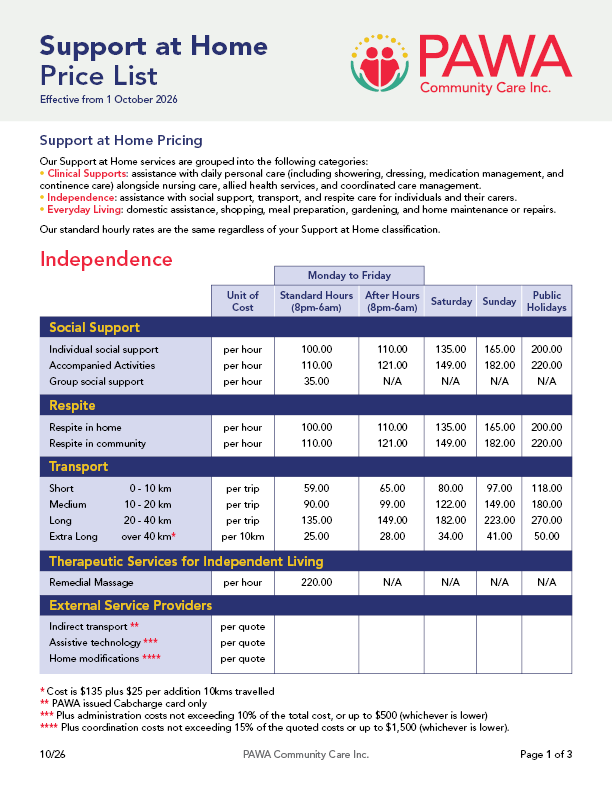
View or Download our SAH Price Guide below (PDF):
For queries, please contact our friendly team on
1300 227 292
Additional Conditions
Cancellation Policy: A cancellation fee equal to the full cost of the scheduled service applies to cancellations made with less than two (2) business days’ notice. If sufficient notice is not provided, the full service fee may be charged.
Exceptions may apply, and the cancellation fee may be waived on a case-by-case basis where there are reasonable grounds.
Preferred Worker or Subcontractor Requests: If you choose your own sub-contractor or request a preferred worker to deliver services, this may attract a higher rate and we will supply a quote.
Price Increases: Our prices may increase up to twice per financial year with at least 14 days’ notice, by the greater of 5%, any increase in CPI, average wage increases for home care staff or increases in operational costs.
Estimating and confirming your contributions
You can use the Support at Home fee estimator on myagedcare.gov.au to estimate how much you may need to contribute towards your Support at Home services and to help plan your budget. The estimator asks for information about your pension status, income and assets.
Your actual contribution rates are determined through an income and assets assessment. Services Australia generally completes this assessment. If you receive a means-tested payment from the Department of Veterans’ Affairs (DVA), DVA may complete the assessment instead.
If you are a full or part pensioner, Services Australia will generally use the income and assets information it already has from your pension assessment. If you are a Commonwealth Seniors Health Card holder or a non-pensioner, such as a self-funded retiree, you may need to provide your current financial information if Services Australia does not already have it.
If you are a member of a couple, half of your combined income and assets is included in the assessment, regardless of who earns the income or owns the assets.
To have your contribution rates calculated, you can complete the Support at Home calculation of your cost of care form (SA456) through Services Australia. You can also apply online through your Centrelink online account via myGov. You don't need to complete SA456 if Services Australia already has the financial information it needs from a relevant income support payment.
Once your assessment is complete, Services Australia will send you a fee advice letter showing the contribution rates that apply to you. You can have your income and assets assessed before you start receiving care, but your fee advice letter is valid for 120 days from the date of your assessment. If you don't enter care within that period, you may need another assessment.
If you choose not to provide your income and assets information, you will be given a ‘means not disclosed’ status and will be required to pay the maximum contribution rates.
Under Support at Home, the amount you contribute also depends on the type of service you receive. Clinical supports are fully funded by the Australian Government, while contributions may apply to independence and everyday living services. From 1 October 2026, approved personal care services will move into the clinical supports category and will be fully government funded, meaning you will not pay a contribution for approved personal care services delivered from that date.
Financial advice, education and assistance
You should consider obtaining independent financial advice before deciding how to manage or pay for your aged care costs. The way you arrange your finances may affect your pension and aged care costs.
Services Australia's Financial Information Service (FIS) provides free information and education to help you understand your financial options, including the financial implications of aged care. FIS Officers can explain financial matters and help you make informed decisions, but they are not financial planners or financial counsellors and do not provide personal financial advice.
To speak with a Financial Information Service Officer, call 132 300 and say “Financial Information Service” when prompted. The Older Australians line is available Monday to Friday, 8 am to 5 pm.
Financial hardship assistance
If you are experiencing genuine financial hardship and cannot afford your Support at Home contributions for reasons beyond your control, you may be able to apply for financial hardship assistance, also known as a fee reduction supplement.
Eligibility is assessed on an individual basis. If you are eligible, the Australian Government may pay some or all of your Support at Home contributions.
For more information, including eligibility requirements and how to apply, see Financial hardship assistance on myagedcare.gov.au.
Enquire Online
Submit an enquiry using the form below and one of our team members will contact you within 24hrs or email us at info@pawacc.org.au

Book a Free Consultation
Book a call or visit with us! We’ll be happy to answer all of your questions about our Aged Care Services and clarify any concerns you have about the process. We can also provide you with advice if you’re looking to make a switch from your current provider - let us know and we’ll guide you through the process.
Our staff will discuss everything from you or your loved ones requirements to concerns, surroundings, lifestyle and preferences to better understand the type of care you need.